Visualizzazione post con etichetta Abraham Maslow. Mostra tutti i post

giovedì 14 febbraio 2013

ASSESSING SELF-ACTUALIZATION (by Michael Hall -- Neuro-Semantics)


One of our purposes in Neuro-Semantics is to enable ourselves and others to actualize, or make real, our highest and best.  Highest refers to your highest visions about life, your values for how to live, and meanings for making life meaningful.  Best refers to your top performances, your best skills and competencies, and taking your actions so that they reflect you when you are in the zone of performance.  Yet to do that with mindfulness requires that we be able to assess where we are now and where we are as we progress, in other words, assessment of our self-actualization.  And that means creating benchmarks for self-actualizing development.

The first attempt to do this occurred in 1964 when Everett Shostrum met with Abraham Maslow and took the 15-17 characteristics of self-actualizing people, which had been discovered in over 20 years of modeling, and began to create behavioral indicators of those characteristics.  The result?  The POI, the Personal Orientation Inventory, a questionnaire of 150 force-choice questions around 10 subsidiary distinctions of living the self-actualizing life.  The POI was, and continues to be today, a well developed instrument for measurement and assessment.  And if it weren’t so expensive, I’d been promoting it in all we do in Neuro-Semantics, but alas, to take it and use it costs $128 for each person, each time.

When I complained about that some years ago (2009), Tim Goodenough challenged me to begin creating our own assessment scale.  In January 2010, Tim and I completed a prototype and ran it with the Leadership Team of Neuro-Semantics.  Since that time, we refined it, I wrote a description of it, and lo and behold, we have our very own Neuro-Semantic Self-Actualization Assessment Scale.  You can now find it on the website:http://www.neurosemantics.com/assessment-scale-form.

This Assessment Scale invites you to look at your driving needs— those lower and higher needs that drive your neurology, physiology, and psychological states of mind and emotion.  For each of the four lower needs and for the fifth level of self-actualization needs, you will find seven or more distinctions.  The scale invites you to gauge yourself in terms of how well are you adequately meeting your needs.  Are you just “getting by?”  Then you would put a check in the middle.  If you are not getting by very well, then you will be to the left in the red zone.  If you are more than just getting by, you are thriving or optimizing, you will be to the right of the center line, in the green zone.

Getting by refers to being able to fulfil the need so that the drive goes away.  That’s how the lower needs work.  When adequate gratified by true-satisfiers (things that truly correspond to and fit the need), then the disequilibrium, the inner tension, the driving urge reduces and then vanishes from awareness.  That will be a first sign of using a true satisfier.  Another sign: energy!  Vitality.  You will feel good and be able to focus on the next-level needs.

If you are not using true-satisfiers, but false-satisfiers, then the drive doesn’t go away.  In fact, the drive for that need, whether food, drink, shelter, money, sex, etc. will dominate more and more.  You may become obsessive about it, and then compulsive in your actions.  False-satisfiers and false-beliefs about our needs, for us humans, will create neurotic needs.  We will semantically load the need with meanings, understandings, beliefs, etc. that the need cannot bear and the result we will become obsessive-compulsive about the need or some false-satisfier (drugs, money, gambling, etc.) and the false-gratification makes things worse.

Now you can assess where you are and how you are dealing with, handling, coping, and hopefully mastering your innate driving needs.  The lower needs are “animal” needs because the higher intelligent social animals have those needs as well— the need not only for survival and safety, but for connection, bonding, belong, and for recognition of their place in a group.  The mechanism that drives these lower needs is deficiency and so Maslow designated them, the D-needs.  These are the needs that do not go away until fulfilled.  And when fulfilled, they go away.

The higher or self-actualization needs are those which are with us from the beginning— in nascent form– but which become fully present to us as we fulfill the lower needs.  These are the uniquely human needs.  These are our needs for knowledge, meaning, understanding, beauty, order, mathematics, excellence, fairness, justice, contribution, making a difference, giving love, etc.  The mechanism governing these needs is abundance and being-ness.  Abundance means that when you gratify them, they grow.  They do not go away, they do the opposite— they expand and become fuller.  Being-nessmeans that unlike the lower needs that are instrumental needs, means to an end, these are non-instrumental, they are ends (not means).  These are for living in, for being, they are valid and satisfying in and of themselves.

So where are you?  Go and take the assessment.  It will take 30 minutes when you do it the first time and then you can print off the results.  Each time you do it thereafter, will go quicker and quicker as you get more acquainted with it. 

L.  Michael Hall, Ph.D.


Everyone as best as he can...
Have Joy!
Giannicola
 

mercoledì 16 gennaio 2013

A HAPPY NEURO-SEMANTIC YEAR TO YOU! (by Michael Hall -- Neuro-Semantics)

2013— a new year has just arrived!  And what does that mean?  Lots of things.  One meaning is about time: the field of NLP is now 38 years old (1975), the field of Neuro-Semantics is now 19 years old (1994), and this past November we celebrated the 10th year of Meta-Coaching.  And to put everything into historical perspective, the beginning of the first Human Potential Movement occurred 74 years old (1938).  I put it beginning in 1938 because that was the year that Abraham Maslow began the first modeling of excellence project— when he began his “Good Humans Studies” using Ruth Benedict and Max Wertheimer as his first self-actualizing subjects.

That study became the very first modeling excellence project as Maslow and his colleagues set out to find the characteristics of those people who had found the secret of living at a higher level than just coping with the lower, animals needs of survival, safety, love and affection, and self-importance.  Maslow discovered that they were living for the self-actualizing or being-needs —the truly human needs.  He discovered that people who did so were often, and sometimes frequently, blessed with joyful and ecstatic moments that he called “peak experiences”— moments of pure happiness.

Ah, yes, moments of pure happiness.  Such moments were seldom if ever directly pursued by the subjects of his studies.  What they pursued directly were one or more of the being-needs— knowledge, meaning, excellence, beauty, mathematics, music, justice, contribution, making a difference, etc.  Yet in the pursuit of something great that was outside of themselves, they found themselves lost in some fascinating engagement as they extended themselves and became their best selves (actualizing their highest and best potentials) and then, Eureka!  Suddenly, and unexpectedly, they would have one of those moments of pure happiness.

Many other wise men and women have noted this same phenomenon, namely, that happiness is a consequence of giving yourself to something great, something bigger than yourself.  This was also Viktor Frankl’s notion of happiness.  Happiness results as the by-product of forgetting yourself in a task that draws on all of your imagination and talent.   Paradoxically, happiness does not come when directly pursued.  Nor is happiness the same as “pleasure,” happiness is of a different quality, a different dimension.  Instead, happiness comes as a consequence of giving the best of yourself to something that for you is the highest of your values and visions, that makes a contribution to the rest of humanity.

So in wishing you a Happy New Year! from a Neuro-Semantic point of view, we are wishing you many moments of pure happiness, of ecstatic joy and delight, of peak experiences where you are “surprised by joy” as you find yourself totally engaged in something that brings out your best, that is highly meaningful and significant to you, and that requires the kind of playful effort of giving something your all.

To say Happy Neuro-Semantic New Year!  is to wish that you find your highest and richest meanings and that as you do, you turn them into your best and most competent performances. Then you will be able to step up to your highest being-drives and experience one of those moments of self-actualizing, a peak experience.

All of this fits Neuro-Semantics because closely related to the idea of meaning and meaning-making, purpose and intentionality which lies at the heart of this field is the notion of happiness— or joy — or flow — or a peak experience — or lost in an engagement so significant and meaningful that you seem to experience a transcendence of the moment and for a brief time live in the eternal now.  And that’s the very point of our flagship training, APG — Accessing Your Personal Genius.

The point of APG is that your personal genius state is not so much about increasing your IQ, or becoming a genius like the classical geniuses of the twentieth century.  The point is becoming the best you that’s possible for you to become.  It is to become fully and completely you — you with all of your resources available so that when you engage yourself into what’s meaningful to you, you can get so focused that you get lost in the moment.  And when you do this—you will have many of those moments of pure happiness.
                                               
Mihalyi Csikszentmihalyi noted in his dissertation work on Flow — the structure of happiness— it is not when you are in the moments of flow that you feel happy or joyful.  No.  In those moments, you feel engaged, captivated, enthralled as you put forth your best and highest efforts.  It is in the moments afterwards as you reflect on that flow experience that the sense of satisfaction and joy comes.  Actually for him, we enter this flow state when we are engaged in an activity in which we have control of our actions and responses and so can develop a sense of mastery in that area.  And because this is meaningful to us, it generates feelings of being happy.

If peak experiences are those happiest moments of life— moments of rapture and creativity that give us a sense that “Life is Good!” then may 2013 be a very happy new year for you and yours.  May you have a Happy Neuro-Semantic New Year!

L. Michael Hall, Ph.D.
Everyone as best as he can...
Have Joy!
Giannicola 

mercoledì 7 novembre 2012

LEADERSHIP CONTESTUALE


"Perdere un'illusione rende più saggi che trovare una verità" così diceva nel 1840 Ludwig Börne. Ebbene, non lo so se è così ma credo che le due situazioni, paradossalmente, siano legate insieme. Cioè credo che se perdo un'illusione accedo ad un'altra illusione che per me diventa una nuova verità (come quella che chiamo illusione ora o chiamavo prima...). 

Ma cosa c'entra questa introduzione con la Leadership Contestuale?
Abraham Maslow diceva: "le persone Auto-Realizzate sono quelle che non hanno nulla di più rispetto alle altre, la differenza sta nel fatto che a loro non è stato tolto nulla"... e allora mi ricollego alla prima affermazione di Börne nel momento in cui l'illusione che perdiamo fosse un'illusione tossica; quelle del tipo: "non posso farcela", "non ho le qualità", "chi sono io per riuscirci?", ecc...
Siamo illusi, capita molto spesso, che se una persona è il numero 1 in un campo, lo sia in ogni campo... Ora, sei sicuro che Roger Federer, cambiando contesto, possa continuare ad essere il n. 1 al mondo?


Ognuno come può...
Abbi Gioia!
Giannicola

mercoledì 21 marzo 2012

DISCIPLINED INNOVATION (by Michael Hall -- Neuro-Semantics)


Talking about disciplined innovation looks like going down a rocky road. It could make you think to have problems and difficulties to deal with it. 
Dr. Michael Hall says: "Innovation makes the world go round!", and Innovation goes in pair with Creativity.
I warmly suggest this post:

DISCIPLINED INNOVATION
(The Secret for being Creative and Successful)
Innovation makes the world go round!  If we do not innovate new products, new services, new information, new experiences— our businesses will not keep developing, growing, progressing, and succeeding financially.  Businesses must innovate.  Bill GatesBusiness At the Speed of Thought, noted that every product at Microsoft will be redundant in three years.   Three years and the business has nothing to sell that anyone would want!  How about that for pressure!

Back in the 1950s Abraham Maslow was recognized as one of the foremost thinkers, developers in the field of Creativity.  And why not?  By then he had been modeling for over a decade self-actualizing people and noting how they were so innately creative and how they were the ones actualizing new ideas into products, services, businesses, etc.  In doing so, Maslow sorted out primary and secondary creativity and distinguished it from innovation.

“Inspirational ideas are a dime a dozen” he wrote.  And why?  Because merely having great ideas, big ideas, and inspirational ideas is not enough.  If you don’t know how to innovate the great idea, if you don’t have the discipline, consistency, dedication, commitment, and persistence to make the idea real and actual, the creativity will never amount to anything.  You will be a dreamer— poor and unsuccessful, and your creativity un-actualized.

All of this has been recently re-discovered in the research that Jim Collins and Morten Hansen has conducted on highly successful companies.  In their book, Great by Choice: Uncertainty, Chaos, and Luck— Why Some Thrive Despite Them All (2011), they reveal what their latest research has indicated about the companies that actually thrive in the chaos of the turbulent and tumultuous events of recessions, change, and uncertainty.  Now they thought and expected that innovation by itself would be the trump card.  To their surprise, it wasn’t. 

The companies that far exceeded the comparison companies, exceeded them by 10-times (hence “10X companies”) “were not necessarily more innovation than their less successful companies.” (p. 73).  In fact, Gerard Tellis and Peter Golder Will and Vision studied 66 wide-ranging markets and found that only 9 percent of the pioneers of innovative products ended up as the final winners in the market.  In fact, 64 percent of the pioneers failed outright.  Obviously, pioneering new stuff by itself is insufficient—it isn’t the big secret for success.

So what’s going on?  What’s missing?   Collins and Hansen discovered that the secret ingredient that made the difference is disciplined innovation.  About innovation they discovered that innovation without discipline inevitably leads to disaster (p. 77).  “It’s a discipline game, a scale game, a systems game, not just an innovation game.”  Yes you have to innovate, but above the threshold level for innovation in a given industry, being “more innovative” doesn’t seem to matter very much.”  What matters is the mixture of creative innovation with discipline.  In fact, there has to be “fanatic discipline and empirical creativity.”

And what does all this mean?  What is this discipline?
Discipline is consistency of actions— consistency with values, with long-term goals, with performance standards, consistency of method, consistency over time.  True discipline requires the independence of mind to reject pressures, and long-term aspirations.

“For a 10Xer, the only legitimate form of discipline is self-discipline, having the inner will to do whatever it takes to create a great outcome, no matter how difficult.” (p. 21)

And what does “empirical creativity” mean?  It means have a specific methodology, being able to identify the specific details that make the difference, recognizing what works, how it works, why it works, and then setting up a methodology that can be repeated and doing it consistently.  It is being specifically methodical and doing so consistently.
“No human enterprise can succeed at the highest levels without consistency.  If you bring no coherent unifying concept and disciplined methodology to your endeavors, you’ll be whipsawed by changes in your environment and cede your fate to forces outside your control.” (p. 145)

The energy for creativity and the power to actually create an innovative product or service may sound easy and simple.  It is not.  Long after the creativity and inspirational ideas comes the discipline to make it real.  That’s why so many “creative people” with great ideas are not able to innovate them for practical results.

So what’s the solution?   Easy, the solution is to create a synergy between your meanings and your performance.  Your meanings— the creative ideas; your performance— your ability to actualize, to translate into action, to innovate in actual experience.
You can read about all of this in Neuro-Semantics: Actualizing Meaning and Performance (2011), in Self-Actualization Psychology (2010), and in Achieving Peak Performance (2009).

L.  Michael Hall, Ph.D. 


Everyone as best as he can!
Have Joy
Giannicola


martedì 28 febbraio 2012

THE ULTIMATE CREATIVITY (by Michael Hall -- Neuro-Semantics)


I found these following questions easy on the eyes:
- How creative are you as a parent?
- How creative are you in exercising and staying fit and healthy?
- How creative are you in your relationships?
- How creative are you in enjoying the small pleasures of life?
- How creative are you in cooking a meal?  In designing your career?
- How creative are you in your wealth creation and financial independence?
A new fantastic post by Michael Hall on Creativity and Innovation field.


There’s creativity and then there is self-actualization creativity.  The first is what we all inherit as human beings—our ability to create things.  In this, everybody is creative.  And the reason for this is our lack of instincts.  We are born with a knowledge gap about how to be human—we do not naturally, intuitively, instinctively know that.  That is the gap within us that we have to fill— and fill it we do.  And this explains the tremendous range of how to be human and how to create human cultures that there are.

Without instinctive knowledge hard-wired into our DNA, the knowledge gap of the content of how to be the species that we are is wide-open for us to invent all kinds of ways.  And invent them we do.  This is the foundation of creativity.  It begins as we create our thoughts, our ideas, our hopes, dreams, fears, dreads, terrors, etc.  Thinking itself is an act of creativity.  We cannot not escape from the demand of creativity.  Even when we try to give up all individuality, all uniqueness, all personality, personal responsibility and try to conform perfectly to what other’s want, say, require, demand, etc. —even that is an act of creativity!

As we cannot escape being creative, we cannot turn off the creativity.  In fact, even when we close our eyes and rest in the comfort of sleep—we are creative!  Our nature as creative beings is seen in our sleep—in the wild and crazy ways that we dream.  Released from the constraints of daytime reality, we are free to wildly create in our night-time reality.  This reveals our creative nature.  It’s within us.  Creativity is what we are in the deepest part of our nature.

In the field of Creativity, the problem to solve is not how to become creative, how to think creatively, how to invent new ideas about things— the problem to explain is actually the opposite.
“How are some people so uncreative?  What kills their creativity?  What are the leashes that imprison some people to fail to tap into their God-given, innate creativity?  Why and how do some people escape creativity into bland and stale conformity?  What is so fearful for them to be what they are—creative human beings?”

This is the problem.  In the Training Manual, Creativity and Innovation,the Executive summary begins with the following words:
The ultimate creativity is the self-actualization process—self-actualizing as a human being.  This refers to how we create our self and our sense of reality.  Regarding this, Maslow wrote the following as his opening statement in Toward a Psychology of Being (Chapter 4, The Creative Attitude, 1963).
“My feeling is that the concept of creativeness and the concept of the healthy, self-actualizing, fully human person seem to be coming closer and closer together, and may perhaps turn out to be the same thing.” (1971, p. 55)

So self-actualization creativity is using your innate creativity to createyour highest visions and values and then to actualize those in real life as your contribution.  Self-actualization creativity begins with a specific focus for creativity as it focuses first on creating yourself.  Traditionally, we refer to this as maturing, growing up, developing, becoming an authentic and responsible human being.  The Self-Actualization Psychology of Neuro-Semantics frames all of that as using and beingthe creativity built within us.  We frame that as self-actualization psychology.

Commenting on all of this, Colin Wilson, one of the biographers of Maslow wrote the following in New Pathways in Psychology:
“Maslow’s observation [is] that all self-actualizers are creative—sometimes artistically or scientifically, sometimes in more down-to-earth ways; but always creative.”  (p. 169)

To self-actualize is to discover, enjoy, and fully experience your own unique creativity.  So, using that as a gauge, how much of a self-actualizing life are you now living?  How much more of a self-actualizing life is possible for you?  How much have you unleashed to this date?  What do you need to be unleashed from so that you can fully experience your innate creativity?  What would you like to invent and innovate into the world?
∙           How creative are you as a parent?
∙           How creative are you in exercising and staying fit and healthy?
∙           How creative are you in your relationships?
∙           How creative are you in enjoying the small pleasures of life?
∙           How creative are you in cooking a meal?  In designing your career?
∙           How creative are you in your wealth creation and financial independence?

The final stage of creativity is innovation.  Innovation enables you to take your creativity to market.  Whether it is creative ideas, products, information, or services, you are creative enough to successfully translate your great ideas into something that adds value and creates wealth for ourselves and others.

I write all of this reflecting on how creative a field NLP ought to be and how yet uncreative and non-creative it has been (and actually continues to be today).  Yet NLP ought to be the most creative of fields!  As a meta-discipline about the structure of subjectivity, running our own brains, managing our own states —you would think that NLP people would be among the most creative.  Well, then again, maybe they are.  Perhaps they do have lots of creative ideas.  Yet even if that’s the case, what they are not—they are not creative innovators.  They are not translating those creative ideas into actual processes and taking them to market.  So NLP continues to be a small niche that most people on the planet don’t know about and most of the wonder and magic of NLP is not available to most people.

L.  Michael Hall, Ph.D.

Neuro-Semantics homepage

Everyone as best as he can!
Have Joy
Giannicola

venerdì 17 febbraio 2012

ALLENARSI AL PROBLEM-SOLVING

"Quando l’unico strumento che possiedi è un martello, ogni problema comincia ad assomigliare a un chiodo" Abraham Maslow

GLI UCCELLINI
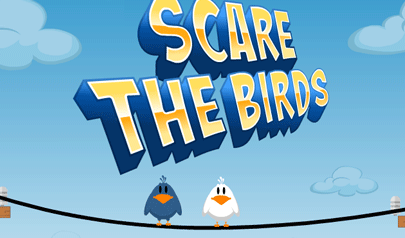
La frase d'apertura è quella che scrissi nel post 3 riflessioni sul Problem Solving del 21 ottobre 2010 e rileggendola mi ha acceso un link al gioco "GLI UCCELLINI" (titolo inglese SCARE THE BIRDS). In questi giorni di neve ho passato molto tempo a casa, davanti al camino, tra letture, tra film, tra amici, tra chiacchierate con i miei bambini, tra un gioco e dei disegni, tra un (molto poco gradito) ripasso di scuola qua e là, ecc... e ho trovato utile scoprire questo gioco online per sviluppare il PROBLEM-SOLVING.

BLOCCATI NEI PROBLEMI?
Parlare di “cambiamento”.
Credo sia importante quando il protagonista sei tu.
Cambiare è possible. E questa è una notizia!
L’altra novità sorprendente è che puoi farlo da solo (con una serie di strumenti adeguati) che ti aiutano nel “problem-solving” e gli attrezzi sono, udite udite, le domande.
 

Questa frase qua, invece, è tratta dal post Bloccato nei problemi? del 17 settembre 2007.


L'ALLENAMENTO
"E recentemente c'è stata una serie di studi interessanti che ha mostrato che il giocare è veramente una specie di programma di ricerca sperimentale", come diceva ieri nel suo speech Alison Gopnik nel post cosa pensano i bambini?.
Le domande sono le prove, i tentativi, gli esperimenti, che farai (nel gioco online che trovi qui sotto) per trovare delle soluzioni; e le risposte sono quelle che ti offre il programma quando ti dice: "livello completato", o "riprova". 
Nel divertimento del gioco trovi una via per allenarti al problem-solving
In questo gioco dovrai fare molta attenzione in quanto è richiesta la capacità di uscire dalla scatola dei "normali" modelli mentali... (non usare, insomma, solo i martello!!!)
;-)


COSA IMPARIAMO
Cosa possiamo trarre, come sintesi operativa, da questo post? Almeno 5 lezioni:
1) imparare dai bambini (mio figlio ha risolto più velocemente di me il gioco proposto oggi);
2) divertirsi nel fare le cose (e magari farle insieme);
3) differenziare i modelli mentali (confrontarsi e provare, poi provare e riprovare, infine prendere una buona soluzione - o meglio il processo che ha condotto fin lì - e riutilizzarla dove serve nel nostro contesto);
4) allenarsi, continuamente, a pensare in maniera creativa (facendo, ad esempio, cose differenti dal solito);
5) frequentare persone creative per sviluppare le nostre skills in questo campo (i bambini sono formidabili in questo tipo di aiuto).


IL GIOCO
Lo avevo promesso nel post di ieri, e allora... buon divertimento (e buon allenamento)!

Gli Uccellini - Scare The Birds - Sì, lo sappiamo, siete un po' perfidi. Passate le giornate a fare dispetti a chiunque. Questa volta il vostro bersaglio sono dei poveri pennuti. Svegliate di soprassalto gli uccelli di Scare The Birds!Posizionate vari oggetti in modo tale da smuovere l'equilibrio di ogni scena. Fate in modo che tutti gli uccellini cadano dal trespolo sul quale sono poggiati per un sonnellino. Completate ogni livello nel minor tempo possibile. Si gioca con il MOUSE.


Giochi - Flashgames.it


Ognuno come può!
Abbi Gioia
Giannicola


martedì 4 ottobre 2011

La grande "P" vs la piccola "p"

Intro
Dalla mia esperienza, sia personale che professionale, viene fuori una cartolina con luci e ombre.
La partita, fondamentalmente, si gioca su due differenti tavoli.

Uno é il tavolo della Preparazione che viene definito con la "P" maiuscola e l´altro, quello del piagnisteo che viene scritto con la "p" minuscola.


Cosa vuol dire?
Che se avessi barattato la Preparazione con il piagnisteo avrei lavorato e lavorerei molto piú di quello che faccio. Altro che corsi, altro che Coaching, altro che ricerca, altro che!

Mi piace quello che faccio e sono fiero di non aver mai fatto ricorso a raccomandazioni o sotterfuggi vari per avere un lavoro.

Ma riflettevo che se invece di proporre dei progetti, delle idee, delle innovazioni, ecc... avessi pianto elemosinando un "aiutino", questo sarebbe valso un congruo aumento di entrate a fine mese.


Chiarezza!
"Non è difficile prendere decisioni quando sai quali sono i tuoi valori" Roy Disney


Ma, a questo punto della storia é necessario chiarire cosa é possibile barattare e cosa no.
La propria Congruenza, no! 
La propria Dignitá, nemmeno! 
La propria Preparazione, neanche a pensarci!

Il proprio proggetto puó essere rivisto e adattato alle esigenze del cliente, dell'organizzazione, ma non puó essere semplificato!
Il punto é che si ha bisogno di maggior tempo per comprendere, abbracciare e lavorare con la complessitá, piú che cercare delle situazioni semplicistiche e pronte per tamponare a breve la mediocritá.


La frase magica...
Funziona un po´ cosí caro Giannicola, devi raccontare che hai due figli e una famiglia da sfamare, le bollette da pagare, e spese che vengono fuori come funghi, ecc... Per favore, fammi lavorare. Altrimenti non ci cacci niente! Questo é quanto mi ha suggerito di dire un direttore, con il quale parlavo un po' di tempo fa, prima di presentarmi al dirigente delle Risorse Umane della sua banca...
Ma lo stesso vale per campi come la politica, lo sport o l´impresa!
E cosí i senza talento, ma con la face-side-bottom (dignitá sotto i piedi o faccia come il culo!), vanno avanti...


Quale Cornice?
Questo ci trascina, almeno, in una cornice di dipendenza e svilimento personale che ha del bizzarro, se si pensa alle parole di Abraham Maslow:
"Ogni bambino possiede le possibilitá per la self-actualization, ma la maggior parte di esse viene messa fuori uso. Penso alla persona che ha raggiunto la self-actualization, non come a una persona normale che ha qualcosa in piú, ma come a una persona normale a cui non é stato tolto nulla. La persona media é un essere umano con poteri inibiti e smorzati".


Concludendo...
Terrorizzato? Sí.
Scoraggiato? No.
Deluso? Nemmeno (vorrebbe dire aver riposto troppa aspettativa in persone mediocri).
E tu, su quale tavolo hai deciso di giocare la tua partita?

Un'amica mi ha suggerito il seguente post, che condivido in rete:
Jeremy Rifkin: LA TERZA RIVOLUZIONE INDUSTRIALE

Ognuno come puó!
Abbi Gioia
Giannicola  

venerdì 13 maggio 2011

KORZYBSKI AND SELF-ACTUALIZATION (by Michael Hall - Neuro-Semantics)

Another neuro-semantics week-end by Michael "the meta-wizard" Hall.


Everyone as best as he can!
Have Joy
Giannicola


Alfred Korzybski Series #14

We could all be genius, says Korzybski, if only we clarify our symbolism and use it effectively.  Then we could actually use our nervous systems the way they are designed in creating maps that keep us sane and able to create a humane science.  To that end he worked to identify how to use “nervous system abstracting.”  Do that and you can step up to a new level of creativity and actualize your potentials.  And while Korzybski only used the term “genius” a few times, he did hold (as did Maslow) that the average person has much more potential of intelligence, creativity, joy, focus, etc. than he tapped into.  And that’s what we mean by self-actualization.

Korzybski’s work was focused on both the neural processes of the nervous systems and the role that our semantics play in it.  Here’s a bit of what Korzybski (1933/1994) wrote
“One can learn to play with symbols according to rules, but such play has little creative value. If the translation is made into the language of the lower centres— namely into ‘intuitions’, ‘feelings’,’visualizations’ etc.— the higher abstractions gain the character of experience, and so creative activity begins.  Individuals with thoroughly efficient nervous systems become what we call ‘geniuses.’” (p. 307)

Maslow and Rogers would later call that a “fully functioning human being” —a self-actualizing person.
“As a descriptive fact, the present stage of human development is such that with a very few exceptions our nervous systems do not work properly in accordance with their survival structure.  In other words, although we have potentialities for correct functioning in our nervous system, because of the neglect of the physiological control-mechanism of our semantic reactions, we have semantic blockages in our reactions ...” (p. 28)

What stops you and me in accessing our personal genius states are our semantic reactions and semantic blocks (which is the reason for several of the previous articles).  Now in his day, Korzybski did not use the term self-actualization; I’m not even sure if the term existed during his time.  It was Maslow’s studies of self-actualizing people in the 1940s that popularized the term and gave it the meanings that we use today in Neuro-Semantics.  What Korzybski did talk about was creativity, sanity, and proper human adjustment.
“We should avoid the mistake of assuming that the average man, or a moron, does not ‘think’.  His nervous system works continually, as does that of a genius. The difference consist in its working is not productive or efficient. Proper training and understanding of the semantic mechanism must add to efficiency and productiveness.  By the elimination of semantic blockings, as in identification, we release the creative capacities of any individual.” (p. 485)

Long before the Human Potential Movement that grew out of Maslow’s work, Korzybski identified the eliminating of semantic blockings as a key process for the unleashing of a person’s potentials.  So while he did not use the language that Maslow and I have about leashing and unleashing, he certainly knew and described these processes.

For Korzybski, it is the realization that we abstract in different levels that we slowly acquire the most creative structural feeling that human knowledge is inexhaustible.  Then we become increasingly interested in more knowledge, we become more curious and more creative— this is actually the very spirit of NLP (something that I discovered decades later, see The Spirit of NLP, 1997).

Korzybski also did not speak about “peak experiences.”  Yet he did speak about the joy of life—  “the joy of living is considerably increased” with the consciousness of abstracting.  “We grow up to full adulthood” and we become mature “for the taking up of life and its responsibilities.”  “Life becomes fuller,” and semantically balanced (pp. 526-527)

In terms of leashing, he noted that ...
“Semantic ‘emotional pains’ absorb nervous energy and prevent a full development of our capacities.” (p. 528)

And about unleashing, it is when you release the semantic reactions and blocks that you stop fighting “semantic phantoms,” and as you do, then stores of energy is released within you which becomes useful for creative purposes.  How you use your neurology in “abstracting” (map making, meaning-making, semanticizing) determines whether you leash or unleash your highest and best potentials.  And that’s why General Semantics and NLP after it has focused on the mapping or modeling processes.  We do not deal directly with the territory (“reality”), but indirectly through our maps.  So the better and more accurate your mapping, including your framing of the mapping as a tentative and fallible process (so you don’t fall into the trap of believing in your maps), the more likely you will be unleashing more of your potentials.


Less than 7 weeks to the First International Neuro-Semantic Conference!

          See details of all of the speakers and workshops at 
          And the Registration form


L. Michael Hall, Ph.D.

CERCA TRA LE CATEGORIE

Neuro-Semantica (730) Self-Actualization (702) leadership (603) ZETETESNEWS (524) Giannicola De Antoniis Bacchetta (466) Creativitá e Innovazione (420) VIDEO (294) FRASE DELLA SETTIMANA (287) extra (141) Michael Hall (131) LIBRI CONSIGLIATI (98) PNL (85) TED (85) teamwork (83) Creatività e Innovazione (79) HBR (45) politica (44) Borsacchio (43) Abraham Maslow (33) BLESSYOU (29) Alfred Korzybski (20) eventi (18) Seth Godin (17) Peter Senge (15) SBROLLA (15) i libri di Susanna (14) Steve Jobs (13) Albert Einstein (12) Richard Bandler (11) il gioco del cervello (11) Lucia Giovannini (9) John Grinder (8) Virginia Satir (8) solidarietà (8) MED (7) Nicola Riva (7) Paolo Conte (7) Randy Pausch (7) Robert Dilts (7) Roseto Sharks (7) ZETEUCI SU ROSETO.COM (7) basket (7) slideshow (7) Aristotele (6) Gregory Bateson (6) Mr. Selfdevelopment (6) Nelson Mandela (6) Walt Disney (6) 24sec. (5) Carlo Maria CIpolla (5) David Byrne (5) Dragos Roua (5) Fabio Celommi (5) Fritz Perl (5) Henry Ford (5) Louise Hay (5) Pick the Brain (5) Bill Gates (4) David Logan (4) Giuseppe Verdi (4) Google (4) IKEA (4) John Lennon (4) John Wooden (4) Killer-Design-System (4) Leo Babauta (4) Martin Luther King (4) Michael Jordan (4) Milton Erickson (4) Pablo Picasso (4) Richard St. John (4) leggi della stupidità umana (4) social network (4) tutta un'altra vita (4) Charles Darwin (3) Chiara Ippoliti (3) Daniel Goleman (3) Daniel Pink (3) Dante D´Alfonso (3) Derek Sivers (3) Edward G. Muzio (3) Giancarlo Alberti (3) Jung (3) Laura Trice (3) Leonardo da Vinci (3) Mihaly Csikszentmihalyi (3) Napoleone (3) Negoziazione (3) Noam Chomsky (3) Oscar Wilde (3) Richard Branson (3) Sir Ken Robinson (3) Socrate (3) The Beatles (3) Tom Heck (3) William Edwards Deming (3) Winston Churchill (3) monkey (3) Ahmed Hakami (2) Alessia Graziani (2) Alexandre Dumas (2) Ali Luke (2) Alison Gopnik (2) Angelo Cioci (2) Antoine Dufour (2) Astrid Morganne (2) Barack Hussein Obama II (2) Barry Schwartz (2) Bart Kosko (2) Benjamin Franklin (2) Buckminster Fuller (2) Buddha (2) Charles Leadbeater (2) Chris Gardner (2) Claudio Bisio (2) Colin Cox (2) Colin Powell (2) Dalai Lama (2) DesJardins (2) Donald Trump (2) Edward de Bono (2) Facebook (2) Forbes (2) Francesco I (2) François de La Rochefoucauld (2) Gail Brenner (2) Gandhi (2) George Bernard Shaw (2) Harry Potter (2) Hidesaburo Kagiyama (2) Ignazio di Loyola (2) James Hillman (2) Jared Diamond (2) Jeff Bezos (2) Jennifer Martin (2) Jim Collins (2) Jim Rohn (2) Joanne Kathleen Rowling (2) John Kenn Mortensen (2) Katsuya Hosotani (2) Luigi Pirandello (2) Malcolm Gladwell (2) Martin Haworth (2) Martin Seligman (2) Matteo Renzi (2) Mihalyi Csikszentmihalyi (2) Napoleon Hill (2) Omraam Mikhaël Aïvanhov (2) Oscar Farinetti (2) Osho (2) Pat Metheny (2) Patrizio Di Marco (2) Philip Zimbardo (2) Ralph Waldo Emerson (2) Rives (2) Sam Leader (2) Seneca (2) Simon Sinek (2) Summerhill (2) Tony Hsieh (2) Tony Robbins (2) Tracy Chevalier (2) Victor Frankl (2) Viktor Frankl (2) Vince Lombardi (2) Voltaire (2) Warren Bennis (2) Wayne W. Dyer (2) Wyatt Woodsmall (2) fun theory (2) il sole24ore (2) starbucks (2) workshop (2) 3M Company (1) ALISSA FINERMAN (1) Aaron Beck (1) Abbe Partee (1) Abramo Lincoln (1) Adam Somlai-Fischer (1) Adrian Reynolds (1) AhnTrio (1) Alan Cohen (1) Alan Fayter (1) Albert Ellis (1) Alberto Bagnai (1) Alessandro Di Fiore (1) Alessandro Manzoni (1) Alex Douzet (1) Alexander Lowen (1) Alexis Ohanian (1) Ali Carr-Chellman (1) Alice Stewart (1) Amellia Barr (1) Amma (1) Amy C. Edmondson (1) Amy Tan (1) Anassagora (1) Anders Ericcksson (1) Andrea Bocelli (1) Andreas Dullweber (1) Andrew Bryant (1) Andrew Grove (1) Andy Hobsbawm (1) Angeles Arrien (1) AnnMarie Thomas (1) Anne Lamott (1) Annie Dickinson (1) Antonio Machado (1) Antonio Maurizio Gaetani (1) Apple (1) Arai Restem (1) Archetipi (1) Arthur Benjamin (1) Arthur Rubinstein (1) Arti Marziali (1) Arun Majumdar (1) Astor Piazzolla (1) BGSA (1) Baba Shiv (1) Baltasar Gracian (1) Baltasar Gracián (1) Barcellona (1) Barrie Davenport (1) Bea Fields (1) Benjamin Disraeli (1) Benjamin Zander (1) Beppe Grillo (1) Bertolt Brecht (1) Bertrand Russell (1) Bill Watterson (1) Billy Swan (1) Blaise Pascal (1) Bob Proctor (1) Bobby McFerrin (1) Bruno Boero (1) CLUETRAIN (1) Cameron Russell (1) Caravaggio (1) Carl Rogers (1) Carla Evani (1) Carlos Castaneda (1) Carmine Gallo (1) Cartesio (1) Cesare Di Cesare (1) Cesare Pavese (1) Champoluc (1) Charles Bukowski (1) Charles Gordon (1) Charles Hazlewood (1) Charles Stanley (1) Charlie Chaplin (1) Charlie Gilkey (1) Chesley Sullenberger (1) Chip Conley (1) Chris Emdin (1) Christopher Hitchens (1) Claude Steiner (1) Clayton Christensen (1) Coach DeForest (1) Colin Wilson (1) Dale Dougherty (1) Dan Ariely (1) Dan Gilbert (1) Dan Peterson (1) Daniel M. Wood (1) Daniel Pennac (1) Daniel Tomasulo (1) Daniel Wood (1) Danny Tuckwood (1) Dante Alighieri (1) Dart Fener (1) Dave Brubeck (1) Dave Meslin (1) David Balakrishnan (1) David G. Myers (1) David Grossman (1) David Henry Thoreau (1) David Lynch (1) De Lijn (1) Debora Serracchiani (1) Deborah Keep (1) Dennis Gabor (1) Desmond Tutu (1) Don Draper (1) Don Kelbick (1) Don Sull (1) Donald Calne (1) Douglas A. Ready (1) Douglas Cartwright (1) Dylan Dog (1) Edgar Allan Poe (1) Edgar Lee Master (1) Edoardo Catemario (1) Elizabeth Gilbert (1) Elizabeth Kolber-Ross (1) Ellen Gustafson (1) Elon Musk (1) Emile Zola (1) Emiliano Salinas (1) Enric Sala (1) Enrico Letta (1) Enrico Sassoon (1) Enzo Jannacci (1) Epitteto (1) Ercole Cordivari (1) Eric Hoffer (1) Eric Lenard (1) Erica Chilese (1) Erich Fromm (1) Ernest Newman (1) Ernesto Sirolli (1) Ettore Scola (1) Eurythmics (1) Eva Di Tullio (1) Evan Williams (1) Fabio Fazio (1) Fabio Vallarola (1) Fabio Volo (1) Farid al-Din 'Attar (1) Federico Mana (1) Fjodor. Dostoevskij (1) Forrest Sawyer (1) Fran Burgess (1) Franco Califano (1) Frank Pucelik (1) Franz Kafka (1) Fred Reichheld (1) Friedrich Nietzsche (1) Fritz Perls (1) Frédéric Cozic (1) GIRLEFFECT (1) GZA (1) Gabriela Andersen-Schiess (1) Gaetano Cuffari (1) Galileo Galilei (1) Garr Reynolds (1) Genndy Tartakovsky (1) George De Mestral (1) George Kelly (1) George Kneale (1) George Miller (1) George Orwell (1) Georges Simenon (1) Gerard Hranek (1) Gerard Tellis (1) Giacomo Rizzolati (1) Gianluigi Zarantonello (1) Gianni Rodari (1) Gill Corkindale (1) Gioia (1) Giorgione (1) Giovanni Allevi (1) Giulio Pedicone (1) Giuseppe Calasanzio (1) Gloria Leung (1) Gordon Brown (1) Grace Murray Hopper (1) Graham Hill (1) Grazia Scuccimarra (1) Greg Northcraft (1) H.Q. Roosevelt (1) H.S. Jennings (1) Hal B. Gregersen (1) Harold Wilson (1) Heidi Grant Halvorson (1) Henry O. Dormann (1) Henry Staten (1) Homer Simpson (1) Howard Hughes (1) Howard Rheingold (1) Hulk Hogan (1) Isaac Newton (1) Isabel Behncke (1) Issy Sharp (1) Italo Calvino (1) Itay Talgam (1) Ivan Pavlov (1) Ivano Fossati (1) Ivo Milazzo (1) J. S. Nye Jr. (1) JK (1) Jack Benny (1) James Cameron (1) James Geary (1) James Joyce (1) Jan Carlzon (1) Jane Goodall (1) Jane McGonigal (1) Jason Green (1) Jay A. Conger (1) Jayasree Goparaju (1) Jean-Luc Godard (1) Jeff Haefner (1) Jeffrey Gitomer (1) Jeffrey H. Dyer (1) Jeremy Rifkin (1) Jim Estill (1) Johann Pachelbel (1) John F. Kennedy (1) John F. Smith (1) John Fante (1) John Galliano (1) John King (1) John Lubbock (1) John Maxwell (1) John Shook (1) John Weakland (1) Jordi Canyigueral (1) Jose Antonio Abreu (1) Joseph Chilton Pearce (1) Joseph Nye (1) Jules Renard (1) Julian Treasure (1) KENT NERBURN (1) Kahlil Gibran (1) Karen Thompson Walker (1) Ken Blanchard (1) Kiran Bir Sethi (1) Kirby Ferguson (1) L'AVVOCATO DEL DIAVOLO (1) LAS mobili (1) Lakoff e Jonhson (1) Lance Secretan (1) Lao Tsu (1) Lao Tzu (1) Lau Tzu (1) Legge di Finagle (1) Leibnitz (1) Leonardo Boff (1) Leonardo Sciascia (1) Linda Burstein (1) Linda Hill (1) Lisa Marshall (1) Lord Chesterton (1) Lori Taylor (1) Luca Maggitti (1) Lucio Battisti (1) Lucy Freedman (1) Ludwig Börne (1) Ludwig Josef Johann Wittgenstein (1) Luigi Ponziani (1) Maison Dior (1) Marc Benioff (1) Marcel Proust (1) Marcello Pamio (1) Marcia W. Blenko (1) Marco Aurelio (1) Marco Paolini (1) Margaret Heffernan (1) Margaret Neale (1) Margarita Tartakovsky (1) Marie-Louise von Fran (1) Marilyn Monroe (1) Mario Andrea Rigoni (1) Mario Monti (1) Mark Hooson (1) Mark Howell (1) Mark Pagel (1) Mark Twain (1) Mark Wilson (1) Markus Zusak (1) Marlen Haushofer (1) Matteo Boniciolli (1) Matthew Child (1) Matthieu Ricard (1) Mauro De Marco (1) Max Wertheimer (1) Meyer e Kirby (1) Michael Breen (1) Michael Bungay Stanier (1) Michael C. Mankins (1) Michael Fred Phelps (1) Michael Pollan (1) Michelangelo Buonarroti (1) Miklos Falvay (1) Misty Copeland (1) Mitt Romney (1) Molly Crockett (1) Moni Ovadia (1) Morten Hansen (1) Mr. Rolihlahla Dalibhunga (1) Muhammad Ali (1) Muriel Spark (1) Nichi Vendola (1) Nick Vujicic (1) Nikola Tesla (1) Nina Jablonski (1) Noreena Hertz (1) Norman Vincent Peale (1) Oliver Wendell Holmes (1) Optimum Mind (1) Otto von Bismark (1) Owen Fitzpatrick (1) Pai Mei (1) Paolo Cardini (1) Patricia Kuhl (1) Patrick Awuah (1) Patrick Hunt (1) Patti Digh (1) Patty Hansen (1) Paul Rogers (1) Paul Romer (1) Paul Watzlawick (1) Paulo Coelho (1) Pavel Florenskij (1) Pepe Rodriguez (1) Peter Crocker (1) Peter Druker (1) Peter Eigen (1) Peter Golder (1) Piero Meldini (1) Pink Floyd (1) Pino Daniele (1) Pippo Lionni (1) Plutarco (1) R. L. Stevenson (1) ROSETO.COM (1) RSA Animate (1) Raghava KK (1) Ramachandran Vilayanur (1) Randall Munroe (1) Re Mida (1) Richard Bach (1) Richard Douglas Fosbury (1) Richard Lavoie (1) Richard Wright (1) Rob Markey (1) Robben Ford (1) Robert Cialdini (1) Robert Cringely (1) Robert Frost (1) Robert Gerrish (1) Robert J. Thomas (1) Robert Kiyosaki (1) Robert Musil (1) Robert Spitzer (1) Robert Thurman (1) Robert and Michele Root-Bernstein (1) Roberto Benigni (1) Roberto Verganti (1) Robin Hood (1) Roger Federer (1) Rollo May (1) Rosa Matteucci (1) Rosabeth Moss Kanter (1) Rowan Atkinson (1) Roy Disney (1) Rudolf Nurayev (1) Rudyard Kipling (1) Ruth Benedict (1) Saffo (1) Sai Baba (1) Sally Kohn (1) Salman Khan (1) Salvatore Natoli (1) San Francesco (1) Sarah White (1) Sean Conrad (1) Sean Murray (1) Sebastian Guerrini (1) Sebastiano Maffettone (1) Sergio Caputo (1) Shakespeare (1) Shashi Tharoor (1) Sherlock Holmes (1) Silicon Valley (1) Stefan Sagmeister (1) Stephen Cave (1) Stephen Covey (1) Steve Karpman (1) Steven Pressfield (1) Susan Jeffers (1) TRECCANI (1) TalentZoo (1) Tangram (1) Tarzan (1) Tata Lucia (1) Thandie Newton (1) Thomas Alva Edison (1) Thomas Edison (1) Thomas Jefferson (1) Thomas Moore (1) Tim Bajarin (1) Tim Berners-Lee (1) Tim Goodenough (1) Timothy Ferriss (1) Timothy Prestero (1) Titti Stama (1) Tom Wujec (1) Tommaso Cerno (1) Tonino Carotone (1) Tony Buzan (1) Tony Hayward (1) Tony Schwartz (1) Totò (1) Tracy O'Connor (1) Tracy O’Connor (1) Trilussa (1) Uma Thurman (1) Vasco Rossi (1) Virgin Mary (1) Virginia Woolf (1) WWF (1) Walt Whitman (1) Walter Bonatti (1) William Blake (1) William Butler Yeats (1) William James (1) William Somerset Maugham (1) William Ury (1) Winnie the Pooh (1) Wystan Hugh Auden (1) Xerox (1) Yang Lan (1) Yoda (1) Yum Yum (1) Zaz (1) Zecharia Sitchin (1) Zenone (1) Zig Ziglar (1) blender (1) fras (1) fratelli Wright (1) iO Tillett Wright (1) john Stuart Mill (1) leader (1) pensiero positivo (1) re del Bhutan (1) rugby (1) santi (1) save the children (1) twitter (1) vivizen (1)